Surprising ways Amazon can break its own rules and get away with it
Amazon is the world´s leading online marketplace growing every day despite the covid-19 pandemic. It is clear why – the constant abundance of different products just on the tip of our fingers. Indeed, the ability to stay safe…
Amazon is the world´s leading online marketplace growing every day despite the covid-19 pandemic. It is clear why – the constant abundance of different products just on the tip of our fingers. Indeed, the ability to stay safe at home while shopping is the attribute many people look for these days. We like accessible things, and we want them quick. That probably won’t change anytime soon, and Amazon knows that very well. Customers might not be feeling concerns raised by Amazon’s breath-taking expansion yet. However, the Amazon sellers who are listing their products at Amazon do. Here are a few ways how Amazon can break (even their own!) rules and be just fine. Or not?
The first step that any Amazon seller always must take is to be informed. From the information comes the possibility and power to change the situation.
Here are some quite surprising ways Amazon can break the rules deliberately, and what to do with it.
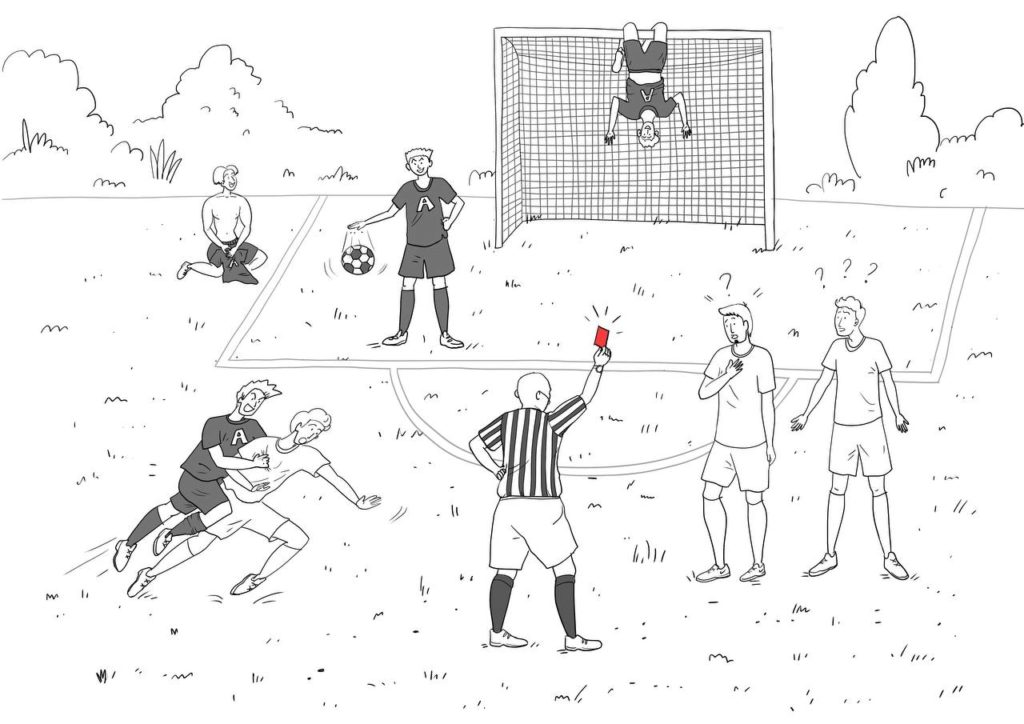
Two ways how Amazon can break the rules
As we mentioned above, the enormous strength Amazon possesses makes it easier to (sometimes very subtly) break some rules. Here are two topics to be concerned about:
- Amazon violates its Terms of Service.
- Amazon just seems to be caring for the Amazon sellers (and workers). When using tricks that make you buy Amazon products (and overlook the Amazon seller’s listings).
1. Amazon violates its Terms of Service
Owner of Amazon and former CEO, Jeff Bezos, once said
“A brand for a company is like a reputation for a person. You earn reputation by trying to do hard things well.” [underlined by us]
Anyone could agree with Jeff Bezos here – maintaining our reputation is indeed hard work. And, unfortunately for Bezos, it is also proved by our actions, not words.
One of the examples is Amazon’s Terms of Service for the writing of the seller’s listings. It is not a surprise that for Amazon to function correctly it is necessary to “somehow” gather many products. Many different “third-party” sellers list these products. It is important to regulate how the sellers get their products on Amazon at such an amount. The possibility to sell products on Amazon undoubtedly helped thousands of small and medium-sized businesses (to reach the customers in online retail). However, there are some issues with the way these third-party sellers offer their products on Amazon. Of course, Amazon Seller Central has to regulate the way a seller can formulate the listing. In the past, Amazon was criticized for the items sold on the site being hazardous (i.e. flammable pajamas for children).
And some of the rules seem to be quite understandable.
For example, Amazon under its “Policies for writing listings” instructs the Amazon sellers not to include in any circumstances in their listing:
- Pornographic, obscene, or offensive content.
- Phone numbers, addresses, e-mail addresses, or website URLs.
- Include details of availability, price, or condition.
- Use Capital Letters only for the beginning of each word. Do not use all Capital Letters throughout the attribute. This applies to Product Title, Bullet Points, and/or Product Description.
- Links to other websites for placing orders, or alternative shipping offers, such as free shipping.
- Spoilers on Books, Music, and Video or DVD (BMVD) listings. This includes giving away plot details crucial to the suspense or surprise ending of a story.
- Reviews, quotes, or testimonials.
- Requests for positive customer reviews.
- Adverts, promotional material, or watermarks on images, photos, or videos.
- Time-sensitive information, such as dates of tours, seminars, or lectures.
Those rules apply to any page titles, descriptions, bullet points, or images related to the listing.
The new “Listing policy” rules appeared in the “Product Details Page Rules”, where Amazon added some more duties for the sellers to fulfill. Most of these “restrictions” for Amazon sellers seem pretty obvious; no one wants to see pornographic content while looking for o new pair of … anything. One would argue that Amazon was in the right mindset of “doing hard things well” while the abovementioned rules were established, or wasn’t it?
The real problem arises when Amazon itself becomes a product seller and when Amazon itself constructs its product listing with a product description.
Yes, Amazon is also an Amazon seller with products ranging from Amazon devices such as “Fire TV Stick with Alexa Voice Remote” to Amazon supplementation (for example “Amazon Elements Glutathione, 500mg, 60 Capsules, 2-month supply (Packaging may vary)”).
Amazon, in its own Terms of Service clearly states that “Phone numbers, addresses, e-mail addresses, or website URLs” are prohibited (see above). , according to the same Terms of Service sellers cannot “use all Capital Letters throughout the attribute, including the product title bullet point and/or product description”.
And here is Amazon’s own product listing, the “Amazon Elements Glutathione”. In the listing, Amazon clearly breaks its own Terms of Service (see here).
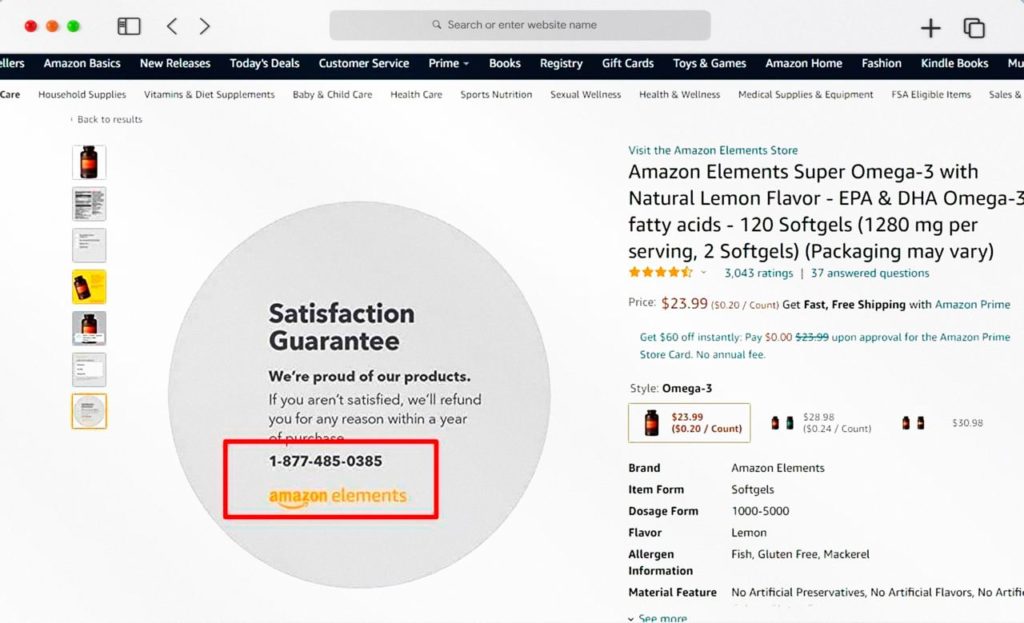
Another example you can find here (where Amazon is clearly breaking the rules against phone numbers)
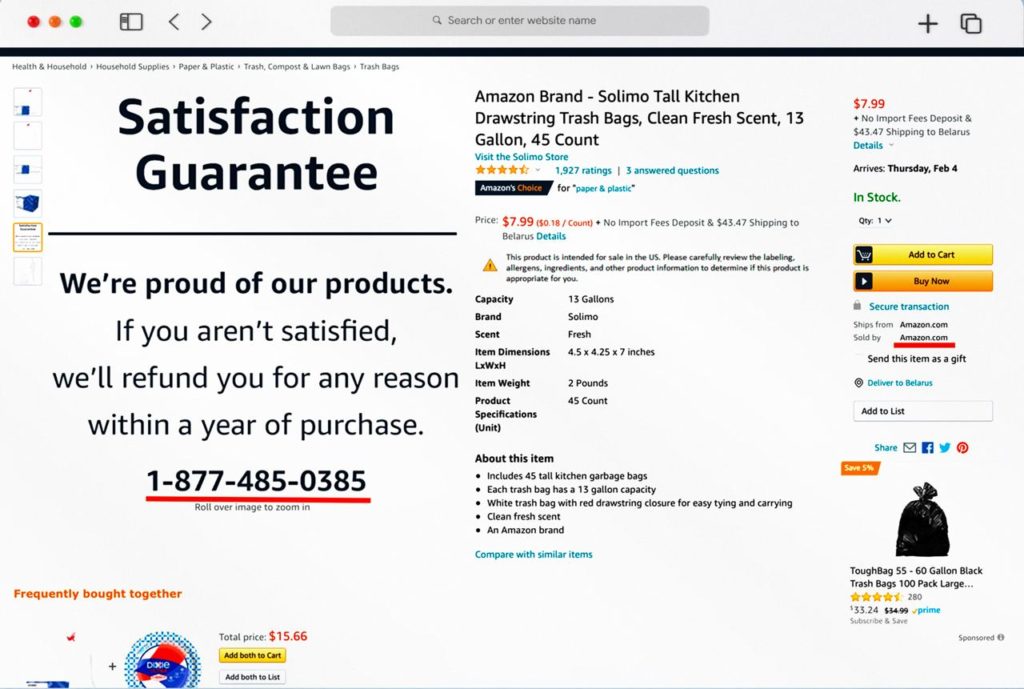
Or here (where Amazon is clearly breaking the rules against capital letters)
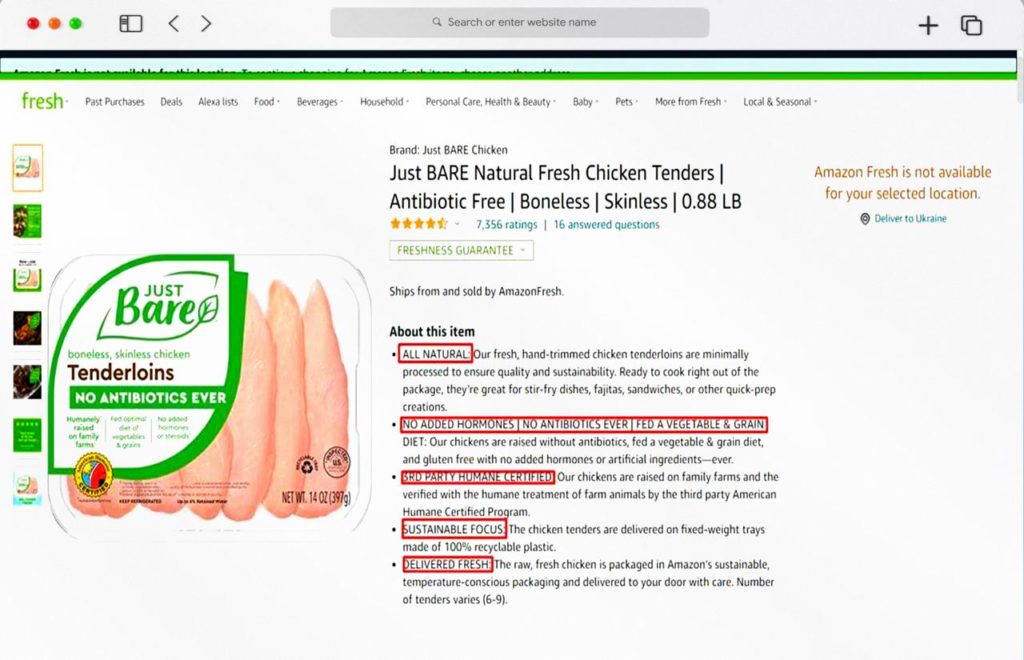
If a seller would be culpable of adding such a picture, Amazon will ban the listing, which would come with an unwanted administrative load for the seller. Multiple bans may end up blocking the whole Amazon seller account, which will freeze seller funds. Amazon may not satisfy the seller’s request to withdraw money from a blocked account, if so, a seller will lose his funds.
The blocked listing creates another potential hazard for the seller – the ban of the entire seller account.
Such a “minor” mistake, as to include the image of your customer information in the product listing, could cost the Amazon seller much needed and valuable time (and money). The worst scenario case scenario equals
- blocked listing;
- banned account;
- money freeze;
- loss of funds.
Yes, the seller’s money related to the account could be frozen. The solution to appeal to the ban of course exists, however the possibility of failure comes in hand with the threat the money would be irrevocably debited from the account.
As Amazon can be quite strict with pursuing such an issue with the seller, how come, that Amazon itself can make such a mistake?
Amazon has great market power, indeed. With such a power, one would argue that comes to a great responsibility. Yet Amazon fails to provide the high standard it requires from its own sellers. And that gives Amazon an unfair advantage.
It can be quite exhausting to be subjected to a double standard. Therefore, it is an understandable question from many sellers – what to do when we come across Amazon’s own faulty listing?
When you find a listing that violates the Amazon Terms of Service rules
When you come across a listing such as the “Amazon Elements Glutathione, 500mg, 60 Capsules, 2-month supply (Packaging may vary)”, please contact us immediately providing the link and screenshot of the issue via contacts mentioned on our page. Please state if you are a customer or an Amazon seller.
As we are helping with “Amazon legal services”, we would assess the claims and might take the necessary steps to address the issue or to add up to already existing claims against Amazon. All of this would undoubtedly be useful for a better future environment at Amazon for the sellers.
2. How Amazon might just seem to be caring for the Amazon sellers
To quote Jeff Bezos again, he once allegedly said that
“I very frequently get the question: ‘What’s going to change in the next 10 years?’ And that is a very interesting question; it’s a very common one. I almost never get the question: ‘What’s not going to change in the next 10 years?’ And I submit to you that that second question is actually the more important of the two — because you can build a business strategy around the things that are stable in time. … [I]n our retail business, we know that customers want low prices, and I know that’s going to be true 10 years from now. They want fast delivery; they want a vast selection. It’s impossible to imagine a future 10 years from now where a customer comes up and says, ‘Jeff I love Amazon; I just wish the prices were a little higher,’ [or] ‘I love Amazon; I just wish you’d deliver a little more slowly.’ Impossible.” [underlined by us]
The shortened version of Amazon’s vision can be “to provide the lowest prices possible for the greatest variety of fast delivered products”. One would argue that this vision is quite grand and also quite hard to fulfill.
Would it be surprising then to know that Amazon might use some “tricks”, in order to do that?
One of the ways is using the “oldest tricks in the book” not only online but also for classic retail. No one says it out loud, but many supermarket chains use psychological tricks to make customers buy the specific brand. As you would visit your favorite supermarket next time, just notice that some brands are just “more visible” than others, positioned at your eye level on the shelves.
Yet how could the online shopper be nudged to choose certain (Amazon’s) brands in online retail, where the buyer is completely free to search for the products of his or her choice by using powerful search tools?
The seller might think that it is the product description and the listings visual that might influence the buyer, yet it is the algorithm that decides what product will come in the desirable first place.
The possibility is high that Amazon uses the power of algorithms to make you buy Amazon private label products and overlook the third-party seller’s listings.
Abusing the dominant position in online retail
In 2020 the European Commission concluded that Amazon might break the market competition rules by using the third-party seller data to adjust the marketplace in its favor. Yet Amazon dismisses all the allegations as “the products of Amazon are beneficial to the customer.” Moreover, Amazon´s way of controlling the prices of third-party sellers by the program “Sold by Amazon” was found to be problematic by US courts.
All over the world, recently in the United States, Amazon is facing some pressure over its quite “innovative” business practices. And in the US, the regulation that would prohibit Amazon from favoring its products was advanced.
For the Amazon seller, it could be quite harmful to be subject to this unfair treatment as such, because the products would not have the sales that they would normally have.
When you find out that the Amazon private label listing is preferred over (above) your listing.
We need to say that many different aspects have a role in the listing position; it might be the seller’s feedback, score, sales metrics, and other metrics. It is also essential to be aware of the Fulfilment by Amazon conditions. Some sellers with the same statistics with the duplicate product listing and similar description also might (with unknown frequency) alter their position overall. It is possible that for some time your listing would be lower than the similar (yet according to your opinion lower) proposal.
Yet when you come across Amazon private label listing above yours, one of the best things you might do is save the arguments to back up your claim (screenshots, specifics) and let us know! As we provide “Amazon legal services”, we would assess the claims and might take the necessary steps to address the issue or to add up to already existing claims against Amazon. All of this would undoubtedly be useful for a better future environment at Amazon for Amazon sellers.
In this article
To sum up, in this article, we introduced two ways how Amazon can break its own rules and possibly harm the third-party seller while doing so. The first way is the double standard of creating and (subsequently) violating the Terms of Service. The Terms of Service provide the rules to which all sellers have to adhere, yet Amazon appears to be (at least) negligent to that. The second way is the possibility, that Amazon is “pushing” its private-label products above the other seller’s listings to gain more profit.
Both can harm the seller and can be quite “problematic.” If you would come across any of these issues – there might be some ways to deal with the situation legally. Please contact us as soon as possible, providing necessary information, details, and screenshots.
Have a problem with Amazon? We can solve it!